Compact—Without Compromising Accessibility
One of the key challenges in the project was making efficient use of the available space. When new equipment is integrated into an existing production workstation, every centimeter matters. The system must fit into the available area without interfering with ongoing operations, adjacent equipment or access for maintenance.
That is why compactness was an integral part of the design.
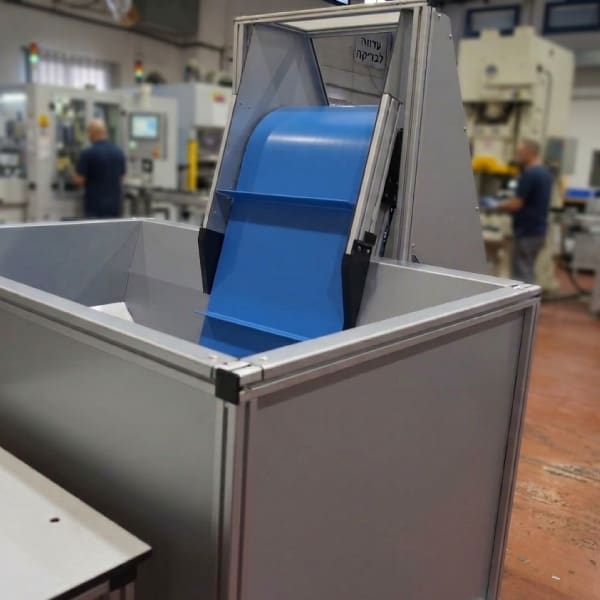
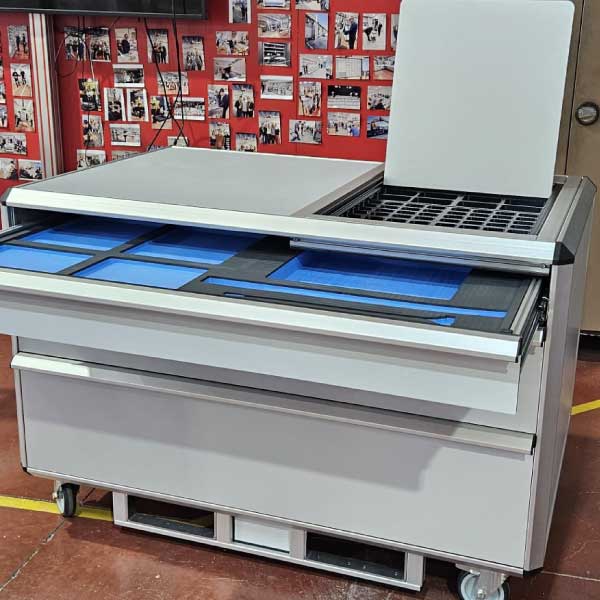
The system was built to transfer the fittings to the inspection and assembly station while fitting within the limited space of the robotic table.
But compactness alone is not enough. An industrial system must remain accessible after installation, which is why maintenance considerations were incorporated into the design from the very beginning.
Designing for the Day After Installation
In industrial conveying systems, accessibility to components is an important part of the engineering process. Motors, gearboxes and drive components need to remain accessible for inspection, servicing or replacement.
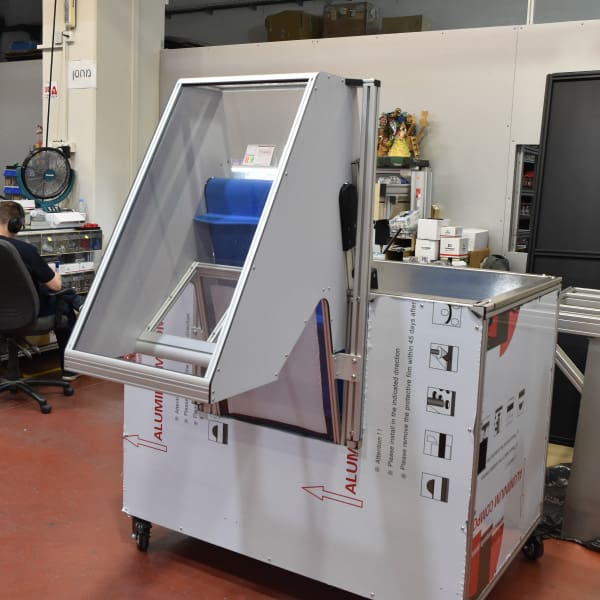
The conveyor system developed for Plasson incorporates removable panels, providing improved access to the internal components of the system, particularly around the drive area.
This approach makes maintenance easier and more convenient, without turning the system into a closed structure that is difficult to access.
It is a design detail that may not be noticeable while the system is running, but becomes highly valuable throughout the equipment’s operating life.
Mobility for Greater Operational Flexibility
The system was also designed with future changes to the production environment in mind.
Unlike a conveyor permanently fixed in one location, the system developed for Plasson can be moved between workstations as required. This provides greater operational flexibility and allows the customer to continue using the system even when the production environment changes.
Mobility was therefore not an afterthought. It was part of the original design philosophy-and directly supports the project’s central objective: to create a system that adapts to the customer’s process and requirements, rather than forcing the process to adapt to the system.
Engineering the Details That Make the Difference
The value of a project like this does not lie in a single component. It comes from the combination of many small engineering decisions: the conveyor structure, material selection, belt configuration, drive assembly, system dimensions, component accessibility and the ability to relocate the system when needed.
For Plasson, the project brought together aluminum profiles, stainless-steel components, custom bending and welding, and a PVC conveyor belt adapted to the product. Each element was engineered as part of one integrated system, based on the specific application requirements.
The result is a conveying solution that integrates into the existing production process rather than requiring the process to be redesigned around it.
The Result: A System Designed for the Application—not the Other Way Around
At the end of the project, Plasson received a dedicated, mobile conveyor system for transferring plastic fittings from the injection molding process to the inspection and assembly station located on the robotic table.
The system combines customized mechanical engineering, a compact structure, a PVC conveyor belt adapted to the product, an integrated drive assembly, aluminum and stainless-steel components, and removable panels that provide improved access for maintenance.
Beyond the transfer operation itself, the design addresses the limitations of the available space and the need for operational flexibility. The system integrates into the existing workstation, can be relocated between stations when required, and provides convenient access to key components for maintenance.
Most importantly, it was designed around Plasson’s specific application.
What Can We Learn From the Project?
This project demonstrates an important principle in industrial automation: the right solution is not always found in a catalog.
When product dimensions, the production environment, existing equipment or space constraints make a standard system unsuitable, trying to force the process into an existing off-the-shelf solution can lead to unnecessary compromises.
A different approach starts with the application itself.
Understand what needs to happen. Examine the product and the working environment. Identify the constraints. Then design the system accordingly.
In Plasson’s case, this approach led to the development of a compact, mobile conveyor system designed to integrate into the existing process and transfer the product to the next station in a way that matches the production requirements.
When an Off-the-Shelf Conveyor Isn’t Enough-Engineer What the Application Really Needs
At Yeruham Automation, projects like this are where engineering expertise, practical experience and a deep understanding of manufacturing environments come together.
If you have a product that needs to move between workstations, limited floor space, existing equipment that cannot be modified, or an application for which a standard conveyor simply does not fit, the right solution may not be to search for an existing system-but to engineer one around the actual requirement.
Have a conveying or automation challenge that you can’t solve with an off-the-shelf solution? Talk to us.